Jul 28, 2009

Gluck: Orfeo ed Euridice

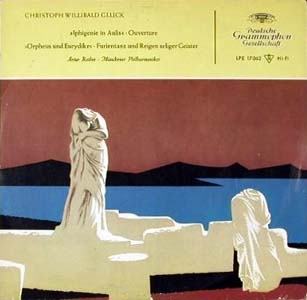
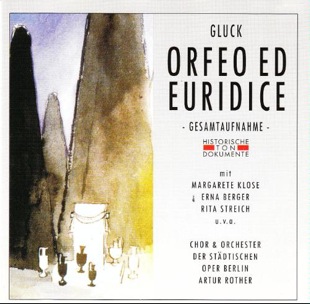
I sometimes come across some good finds while exploring for new works to try out. There is a free Creative Commons MP3 version of Gluck's Orfeo ed Euridice from 1951 with the Berlin Municipal Opera conducted by Artur Rother. I did find reference to an excerpts LP on DG [pictured below] from the period, and this is may be a studio or live performance, released in the US on the Urania label in 1952, but I cannot say for certain this was a DG release or not. Regardless, the cast includes Margatete Klose as Orfeo [female lead replacing castrato], Erna Berger as Euridice and Rita Streich as Amor. The recording is mono of course, but the performance is quite enjoyable and the sound quality acceptable, and it is a good way to be introduced to Gluck's operas.

Now the good part: You can get this recording for free. It has been released online in several locations, but the easiest place is here at Liber.it The page is in Italian, but no problem, scroll to the bottom and you will see the 24 tracks to download. Make sure you right-click to save the files since your browser may try to just play the MP3s. You may want a libretto or at least a synopsis, so check out the links below.

Librettos [under Gluck; ORFEO]
Synopsis at reference.com
MP3 download from Liber.it

Artwork for the Excerpts LP and a recent CD release:

gluckorfeoedeuridice-gluck_dg_307x300-2-2009-07-28-00-07.jpg gluckorfeoedeuridice-cantusclassics-500331-2009-07-28-00-07.jpg

Jun 24, 2009

Thomas Tallis

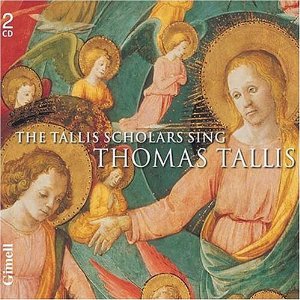
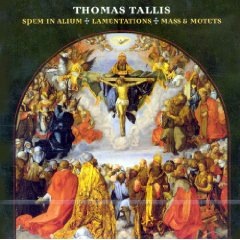
Sometimes, it is easy to miss the works of a famous composer. While I have some selections of Thomas Tallis' choral works on various compilations, I never delved too deep into some of his works. Big mistake, talk about some beautiful music. I have been listening to several Tallis CDs, one by the Tallis Scholars and one by Magnificat. Besides wonderful performances, the sound is excellent and I cannot recommend these albums enough for anyone wanting to explore early choral music. Tallis' works are reminiscent of the Gregorian Chants you have probably heard before, but with a higher range in the vocals, and many of his texts are in English as well as Latin.

Tallis Scholars @ Amazon.com

thomastallis-tallis_scholars-2009-06-24-17-30.jpg


Magnificat @ Amazon.com

thomastallis-pasted-graphic-1-2009-06-24-17-30.jpg


Jun 13, 2009

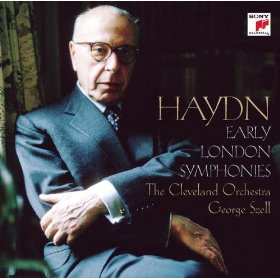
Speaking of Szell

speakingofszell-szell_haydn-2009-06-13-11-21.jpg
Sony Classics has just re-released the Haydn Early Symphony [93-98] recordings by George Szell and the Cleveland Orchestra in a 2CD set! These are great performances, and Szell really brings out the best in these pieces. The sound quality is fine, especially for an older recording, and an excellent way to get these symphonies in your collection. The set is mid-priced, and also available in an MP3 Album version.

You can also listen to a free streaming version [low quality] of the entire CD at Napster.com


Apr 30, 2009

Bach's Goldberg Variations

Of Bach's solo keyboard works, the Goldberg Variations rank at or near the top, a work with an Aria and 30 variations. While there are many recordings on harpsichord or other period keyboards like a pianoforte, my favorites happen to be modern piano performances. My introduction to Bach's Goldberg came in 1982 with the purchase of Glenn Gould's 1981 digital remake of his landmark 1955 recording. Having never heard the original, I had no basis to judge Gould's new interpretation as good, bad, or even to compare it to other artists interpretations. Let me state now that with Gould, you really love or dislike his performances, he does not just play, but puts on a performance, and in actuality may not be what the composer originally intended, but it doesn't really matter in my opinion.

Why should it make a difference which recording I listened to first? Well, if you love a particular record and it is the only version you have, you tend to set in your mind that this is the 'right' way to perform it, whether it is a 'good' recording or not. In hindsight, I am glad to have approached this work with Gould's 1981 as the 'definitive' performance. I am under no illusion that what he did had anything to do with Bach's intentions, or that the 1981 playing is not full of Gould's sometimes bizarre takes on a particular movement. But it is those particular quirks that made me love this piece, and allows me to hear things in it that I would not have appreciated had I heard the 1955 or another recording first. 

Gould's 1981 recording is a radical departure from his earlier one, and in many ways these are not even the same work. Where the 1955 zips along at a practically impossible speed and is treated more or less as one long work, the 1981 thoughtfully takes each section individually, and the contrast can be jarring. Some movements are played at half the speed in the remake. Now whether he sped up in 1955 or slowed down in 1981 is again subject to interpretation. It is easy with an iPod to play both recordings at once, and alternate each CD, playing track 1 of the 1955, then track 1 of the 1981, track 2 1955, track 2 1981, etc. You never feel like you have repeated a track, and on occasion it sounds like you are not even listening to the same work.

Right now I am listening to the 1955 and the 1981 like this, with Murray Perahia's 2000 recording thrown in too as a comparison. I have listened to other recordings, but always end up with the Gould 1981 or 1955, so it was time to once again visit another performer to see if it would stand up. On a track-by-track basis, sometimes Perahia's playing matches Gould's 1955, sometimes the 1981, and others are his own take. One major difference is that Gould rarely took any of Bach's repeats, and Perahia seems to take them all. Not a bad thing, but makes the recording a lot longer. But this is not a fair way to listen to a recording, just an interesting comparison, especially with the two Gould recordings.

To anyone who is a newcomer to this work, I have always had some reservations about recommending Gould, especially the 1981 recording, since there is a lot of Gould mixed in with the Bach. He has a tendency to sing along with his playing, and it is quite audible in the 1981 set. However, Sony released the 'State of Wonder' collection with both the 1955 and 1981 versions in one set a while back, and this is the set I recommend. I lean toward the 1955 as a more 'pure' performance, but the 1981 has so much to offer too. If you are so inclined, go with Gould's set and I feel you will get a lot out of your choice. The 1955 is great, although the sound quality is mono but decent, and the 1981 sounds better, with a much closer piano sound, but you do get the humming of Gould. If this bothers you, Murray Perahia's recording is the way to go. The playing is a little 'soft' for a Baroque work, but still the best alternative in my opinion to the Gould. Perahia's recording is a lot longer because of the repeats, but still quite enjoyable. The piano is not too close, and the piano tone is nice and warm.

RECORDINGS:
Glenn Gould: State of Wonder, 1955 and 1981 recordings
Murray Perahia: Goldberg Variations
Apr 29, 2009

Video of Gould playing Bach's Goldberg Variations 1964

Gould plays selections from the Goldberg Variations:
Aria
Variation 3 (Canon at the Unison)
Variation 6 (Canon at the 2nd)
Variation 9 (Canon at the 3rd)
Variation 12 (Canon at the 4th)
Variation 15 (Canon at the 5th)
Variation 27 (Canon at the 9th)


Video of Gould playing Bach's Goldberg Variations 1981

Be patient, the camera eventually gets to the keyboard, where you can see Gould play.

Mar 29, 2009

Thomas Giovanni Albinoni: Basic Works

Albinoni may be best known for his Adagio for Organ and Strings, used in the movie Platoon. The Adagio is an arrangement by musicologist Remo Giazotto, who discovered a fragment of a work while researching for an Albinoni biography. While a beautiful work, if that is all that you know of Albinoni, you are missing a lot. The closest comparison may be of the works of Vivaldi, and the recommended works are baroque gems.

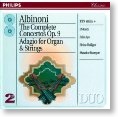
Hogwood and the Academy of Ancient Music give an original instruments performance of the Opus 9 Concertos. This is apparently the first recording of this work on period instruments, and is a full price 2 CD set. Well worth the price, though. Also available as an MP3 Album.

The 2 CD Budget Set by I Musici is also a good recording, and includes the famous arrangement of the Albinoni Adagio. The recordings are from the 1960's, and are of a more romantic vein than baroque, but still is a nice CD. Comes in a bargain MP3 Album also.

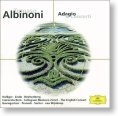
The Bargain Adagio Collection, 'Adagio and Concerti' from DG features the Adagio along with various works from the Opus 7 and 9 Concertos, and is a nice sampler if you want a single CD.

albinoni_hogwood-2009-03-29-22-36.jpgalbinoni_duo_9-2009-03-29-22-36.jpgalbinoni_adagio-2009-03-29-22-36.jpg

Mar 27, 2009

Fasch Orchestral Music

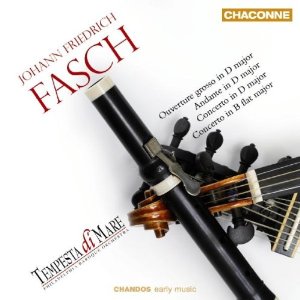
A contemporary of Bach and Telemann, Johann Friedrich Fasch is a lesser known German composer. His major claim to fame is turning down a position at Leipzig, for which the post was eventually by Bach. Tempesta di Mare' has recorded a set of his works on Chandos, and the results are charming. While the style fits in the Baroque suite categories, the works are original with a familiar sound. Definitely a nice diversion to listening to the Brandenburg Concertos for those times when you need some nice classical, but are not quite in the mood for Bach.

The Tempesta di Mare' do a wonderful job of recording these works, and the recording is bright and clear. Apparently this is the first recording of these particular works, and is a great addition to any Baroque classical music lover's collection.

51nImP3QKwL._SL500_AA300_-2009-03-27-11-33.jpg
Read CD Booklet here.

See album at Amazon.com
See album at iTunes Store
See album at eMusic

Feb 27, 2009

Mozart Deal for a short time

mozart99-2009-02-27-22-14.jpg

Amazon has a 99 track MP3 sampler on sale right now for $2.99. A great way to hear a lot of Mozart. These are selections from various works, and probably not the top of the line performances, but at this price, who can pass it up? On sale as of Feb 28, 2009

The 99 Most Essential Mozart Masterpiecesir-2009-02-27-22-14.jpg

Schumann Sonatas for Violin and Piano

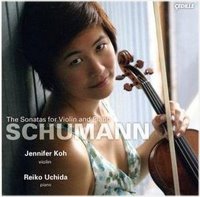
schumannsonatasforviolinand-schumann_violin_koh-2009-02-27-19-51.jpg
I have been exploring some interesting works lately, among them some excellent violin sonatas. Surprisingly, there are a few works that I never had a chance to listen to and was surprised by them. Schumann's Sonatas for Violin and Piano are sublime works, and a great recording is by Jennifer Koh [violin] and Reiko Uchida [piano] on Cedille Records. Schumann has a way with melody and the interplay with between the two instruments definitely makes this more than a violin work with the piano playing a background part. Koh has a full and rich sound, and the recording balance favors the violin, but not by too much.
Link to recording:
Schumann: The Sonatas for Violin and Pianoschumannsonatasforviolinand-ir-2009-02-27-19-51.jpg