From Wikipedia:
Max Christian Friedrich Bruch (6 January 1838 – 2 October 1920), also known as Max Karl August Bruch, was a German Romantic composer and conductor who wrote over 200 works, including three violin concertos, one of which is a staple of the violin repertoire.
Bruch was born in Cologne, Rhine Province, where he received his early musical training under the composer and pianist Ferdinand Hiller, to whom Robert Schumann dedicated his piano concerto. Ignaz Moscheles recognized his aptitude. He had a long career as a teacher, conductor and composer, moving among musical posts in Germany: Mannheim (1862-1864), Koblenz (1865-1867), Sondershausen, (1867-1870), Berlin (1870-1872), and Bonn, where he spent 1873-78 working privately. At the height of his reputation he spent three seasons as conductor of the Liverpool Philharmonic Society (1880-83). He taught composition at the Berlin Hochschule für Musik from 1890 until his retirement in 1910.
His conservatively structured works, in the German romantic musical tradition, placed him in the camp of Romantic classicism exemplified by Johannes Brahms, rather than the opposing "New Music" of Franz Liszt and Richard Wagner. In his time, he was known primarily as a choral composer.
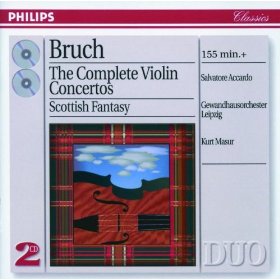
His Violin Concerto No. 1 in G minor, Op. 26 (1866) is one of the most popular Romantic violin concertos. It uses several techniques from Felix Mendelssohn's Violin Concerto in E minor. These include the linking of movements, and a departure from the customary orchestral exposition and rigid form of earlier concertos. It is a singularly melodic composition which many critics have said represents the apex of the romantic tradition.
Other pieces which are also well-known and widely played include the Scottish Fantasy for violin and orchestra which includes an arrangement of the tune "Hey Tuttie Tatie", best known for its use in the song Scots Wha Hae by Robert Burns. Bruch also wrote Kol Nidrei, Op. 47, a popular work for cello and orchestra (its subtitle is "Adagio on Hebrew Melodies for Violoncello and Orchestra"). This piece was based on Hebrew melodies, principally the melody of the Kol Nidre incantation from the Jewish Yom Kippur service, which gives the piece its name.
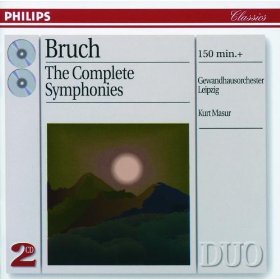
Other works include two other concerti for violin and orchestra, No. 2 in D minor and No. 3 in D minor (which Bruch himself regarded as at least as fine as the famous first); and a Concerto for Clarinet, Viola and Orchestra. There are also 3 symphonies, which, while not displaying any originality in form or structure, nevertheless show Bruch at his best as a composer of fine melodic talent and a gift for orchestration, firmly in the tradition of the Romantics. He wrote a number of chamber works, including a set of eight pieces for piano, clarinet, and viola; and a string octet.